

Austin Real Estate · June 2026 Market Report
What the June 2026 Data Actually Shows
For three years, every Austin market update has read roughly the same way: prices down, inventory up, buyers holding leverage. The June 2026 numbers break that pattern for the first time. Not by much, and not everywhere — but enough that it’s worth walking through the actual data instead of the headlines.
June 2026 Snapshot — Austin Board of Realtors / Unlock MLS & Team Price Daily Briefing
| Metric | Figure | What it means |
|---|---|---|
| Metro median sold price | $450,000 ▲ 1.1% YoY | First annual gain since the 2022 correction began |
| Active listings | 17,303 | Down 1.68% YoY, but still ample choice |
| Avg days on market | 67 days | Time to think, not just react |
| Listings with price cuts | 52.2% | Sellers are still motivated |
| Months of inventory | ~6.0 months | Tightening slightly from a year ago |
| Sold-to-list ratio | 97.6% | ~2.4% below ask, on average |
Three years of correction, and the first real turn
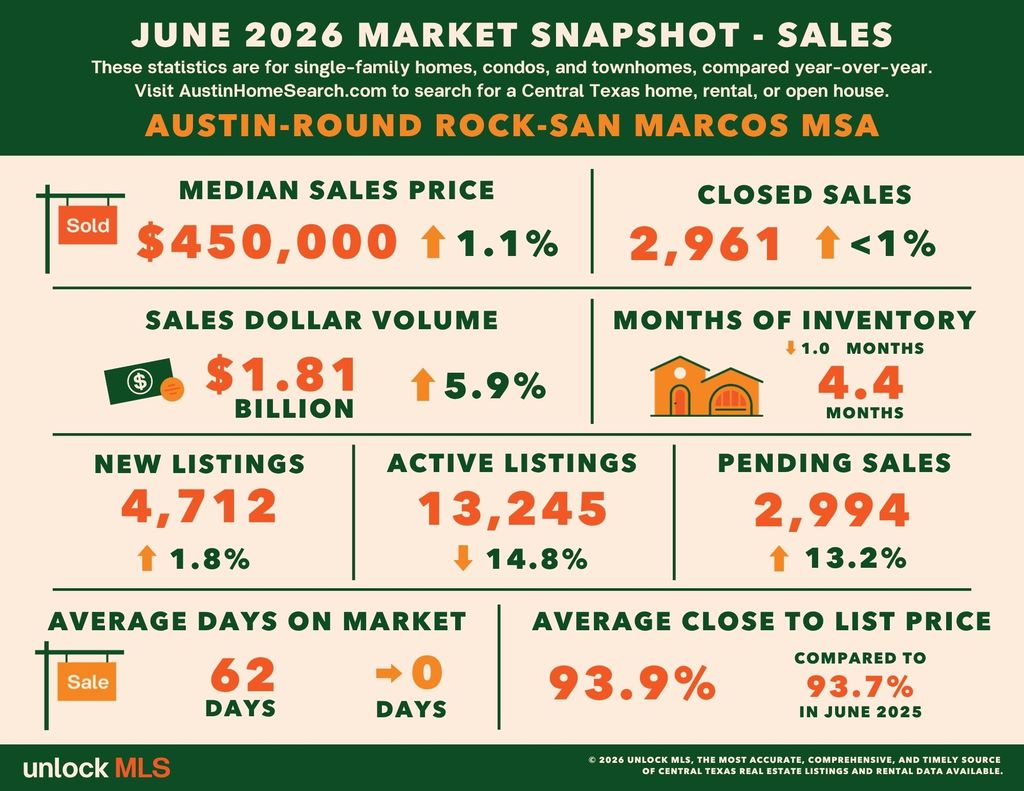
Austin’s housing market peaked in May 2022 with a metro median sold price of around $550,000. What followed was a long, grinding correction — and June 2026 is the first month where the year-over-year comparison finally turned positive. The metro median rose 1.1% year-over-year to $450,000. It’s a modest number, but it’s the first one in this direction in roughly three years, and the trend underneath it has been building for a while: trailing 12-month appreciation across the metro improved from -4.6% (year ending June 2024) to -2.6% (2025) to -2.0% (2026) before this month’s positive print.
The median sold price of $450,000 is still about 18.2% below the May 2022 peak, so this isn’t a market that has fully recovered — it’s a market that appears to be finding its floor. For buyers who’ve been sitting on the sidelines since 2022, that gap still represents real purchasing power. But the direction of travel has changed, and that matters for anyone trying to time this decision.
“Pending sales provide us with an early look at where the market is headed.”
— Vaike O’Grady, Market Research Advisor, Unlock MLS, July 2026
That’s the number worth watching closely: pending sales across the metro rose 13.2% year-over-year to 2,994 contracts in June, per Unlock MLS’s official report — the strongest forward-looking signal in the whole dataset. Pending contracts today are July’s and August’s closings. If that pace holds, the positive price print in June won’t be a one-month fluke.
What 17,300 active listings actually means for you
There are currently 17,303 active residential listings across the Austin metro, per Team Price’s June 17 daily briefing — down 1.68% from a year ago and 843 below the June 2025 peak of 18,146, but still a level of choice that didn’t exist during the 2021–2022 frenzy. Of those listings, 52.2% have already had at least one price reduction, which tells you that more than half the sellers on the market today have already adjusted their expectations once.
To put that in context: in early 2022, Austin had roughly 1,500 to 2,000 active listings at any given time. You had hours, not days, to decide. You waived inspections. You competed against a dozen other offers before your morning coffee. That market is gone, and the June data confirms it hasn’t come back — even with prices ticking up.
Today, you can tour a home, sleep on it, order an inspection, and make a thoughtful offer. The average listing spent 67 days on the market in June, per Homes.com’s tracking — among the longer readings of any major U.S. metro, which is exactly the kind of number that gives a prepared buyer room to operate.
Kevin’s take
Roughly 6 months of inventory is close to balanced, but a 52.2% price-reduction rate tells you the market hasn’t fully repriced itself yet — a lot of sellers are still anchored to last year’s number. That’s still your opening. The homes that are priced correctly from day one are moving in a fraction of that 67-day average. The ones that aren’t are sitting, and those sellers are the ones with real room to negotiate.
Prices by area: the market is not one market
The metro median is a poor guide to what you’ll actually experience on the ground. The median sold price inside the City of Austin is $605,000, up 3.6% year-over-year — the sharpest gain of any area in the dataset, and a sign that the urban core is leading this turn. The outlying counties, as usual, tell a range of different stories.
County breakdown — June 2026, ABoR / Unlock MLS
| Area | Median price | Inventory | Conditions |
|---|---|---|---|
| City of Austin | $605K ▲ 3.6% | 4.3 mo Tightening | Leading the turn; 48 days on market |
| Williamson County | $426.8K Flat | 3.7 mo Low | Leanest supply in the metro; 69 days on market |
| Travis County | $542K ▲ 4.0% | 4.7 mo Balanced | 1,441 closed sales, up 10.7% YoY |
| Hays County | $400K ▲ 9.0% | 4.8 mo Balanced | Gain driven by a thinner, pricier sales mix |
| Bastrop County | $344.9K ▼ 6.8% | 6.6 mo High | Still correcting; real buyer leverage |
| Caldwell County | $260.5K ▼ 10.2% | 5.6 mo High | Most affordable county in the metro |
Williamson County stands out with just 3.7 months of inventory — the tightest of any tracked area — even though its median price is essentially flat year-over-year. If you’re shopping there, you don’t have the luxury of a leisurely pace. Bastrop and Caldwell, on the other end, are still working through real corrections and carry the metro’s deepest discounts from peak.
The rates question everyone’s asking
Mortgage rates have held in the mid-6% range through July 2026 — meaningfully higher than the 3% rates of 2021, and still the single biggest affordability constraint for buyers. But rates in the 6% range aren’t historically unusual; they’re unusually high only relative to the pandemic era, which was the anomaly, not the baseline. Buyers who purchased in the mid-2000s or virtually any decade before 2010 routinely bought at rates above 6%, built equity, and refinanced when conditions improved.
The phrase worth remembering: date the rate, marry the house. You buy the right home now, while the metro is still in a buyer-friendly window, and you refinance if and when rates move. You cannot go back and buy a 2026-priced home in 2028 at 2026 prices — but you absolutely can refinance a 2026 purchase into a lower rate later if one arrives.
Buyer activity is picking up — and the data agrees on both sides
Here’s what tends to get missed in either doom-or-boom market coverage: two independent data sources are now telling the same story. Unlock MLS’s official June report shows metro-wide pending sales up 13.2% year-over-year to 2,994 contracts. Team Price’s independent daily tracking, current as of mid-June, shows pending contracts up 8.0% year-over-year to 5,030 (a broader count that includes new construction), with the pending-to-new-listings ratio improving from 0.79 to 0.85 — buyers are absorbing a larger share of what comes to market even as new listings run about 3% below last year’s pace.
“Today’s market is creating opportunities on both sides of the transaction.”
— John Crowe, 2026 Unlock MLS & ABoR President, July 2026
Team Price’s own framework places Austin’s resale Activity Index — the share of active inventory going under contract — at 22.6%, up from 20.9% a year ago and squarely in what they call the "Softening" phase (20–25%), one step below a genuinely balanced market. It's not a seller's market. But it is measurably firmer than it was twelve months ago, on both the official and independent readings.
What to expect in the negotiation
The sold-to-list ratio of 97.6% confirms that final sale prices are running about 2.4% below the last asking price on average. On a $450,000 home, that gap works out to roughly $10,800. But the more revealing figure is what happens to sellers who overprice and then reduce: the average gap between original list price and final close price runs about 2.2 percentage points wider still — on the City of Austin’s $605,000 median, that’s an additional $13,300 or so left on the table by the seller who guessed high.
In practical terms: the homes worth targeting are those that have already sat 45 to 60 days or more with at least one price reduction. Those sellers have adjusted their expectations and know the market. That’s where negotiating leverage is most concentrated right now — on inspections, repairs, closing costs, and concessions, not necessarily the headline price, since the headline price has just started firming up.
Practical buyer checklist
- Before you start touring: Get fully pre-approved, not just pre-qualified. There’s a meaningful difference, and sellers notice it more now that pendings are up.
- When you’re searching: Look at homes 45+ days on market with at least one price reduction. Check listing history on Zillow or Realtor.com to understand seller psychology.
- On the offer: Ask for a home warranty, closing cost contributions, or a rate buydown — not just a price cut. Sellers are often more willing to help with costs than to reduce the headline number in a firming market.
- On the inspection: Get a thorough one. Buyers still have full inspection rights in most Austin transactions. Flood zone status, foundation, roof age, and HVAC condition are the four non-negotiables. Always check FEMA’s flood map before you fall in love with a property.
- On property tax: Travis County averages 2.1% annually. On a $450,000 home that’s roughly $790/month on top of your mortgage. Model the full cost before you fall in love with a price point.
My honest assessment
I’ve been in this market through every cycle — the slow years, the frenzy, the correction, and now this early turn. Here’s what I’d tell a close friend right now.
If you plan to stay in Austin for at least three to five years, the case for buying has actually strengthened this month, not weakened. Prices are still meaningfully below their 2022 peak, inventory remains ample, and you have time to make thoughtful decisions. But the trend has clearly turned: pending sales are up double digits, inventory is down year-over-year, and June posted the first positive price comparison in roughly three years. The long-term fundamentals of this city — the tech base, the population growth, the quality of life — haven’t changed, and they’re now being joined by a firming market on top of them.
If you’re buying to flip in six months, this still isn’t your market. Transaction costs alone require a longer holding period to pencil out, even with prices firming.
If you’ve been waiting for the “perfect moment” — the lowest price, the lowest rate, the most inventory — I’ll be direct with you: June may have been it, or close to it. That moment rarely announces itself clearly until it’s already passing. What I can tell you is that the conditions right now still favor a prepared buyer more than they have in years — but the window that’s been open since 2023 is visibly starting to narrow.
Ready for a personalized breakdown?
A free market report with current comps, neighborhood inventory data, and a clear picture of what your budget gets you in today’s Austin. No pressure, no obligation.
Get my free buyer report →Data sources
Austin Board of Realtors / Unlock MLS · Unlock MLS Market Research · Team Price Austin Daily Real Estate Briefing · Homes.com Austin Housing Market Report · Zillow Home Value Index. All data reflects June 2026 activity as reported through mid-to-late July 2026. Market statistics are deemed reliable but not guaranteed, and figures from different providers may use different methodologies or geographic scope. Kevin McAfee is a licensed Texas REALTOR® with Vista Realty Group.
